A country can build world-class highways, airports, metro systems and smart cities. But the real progress of a nation should be measured by a much simpler question:
How does it treat a sick and helpless human being ? Unfortunately, in many parts of Northern India, the answer is still deeply uncomfortable.
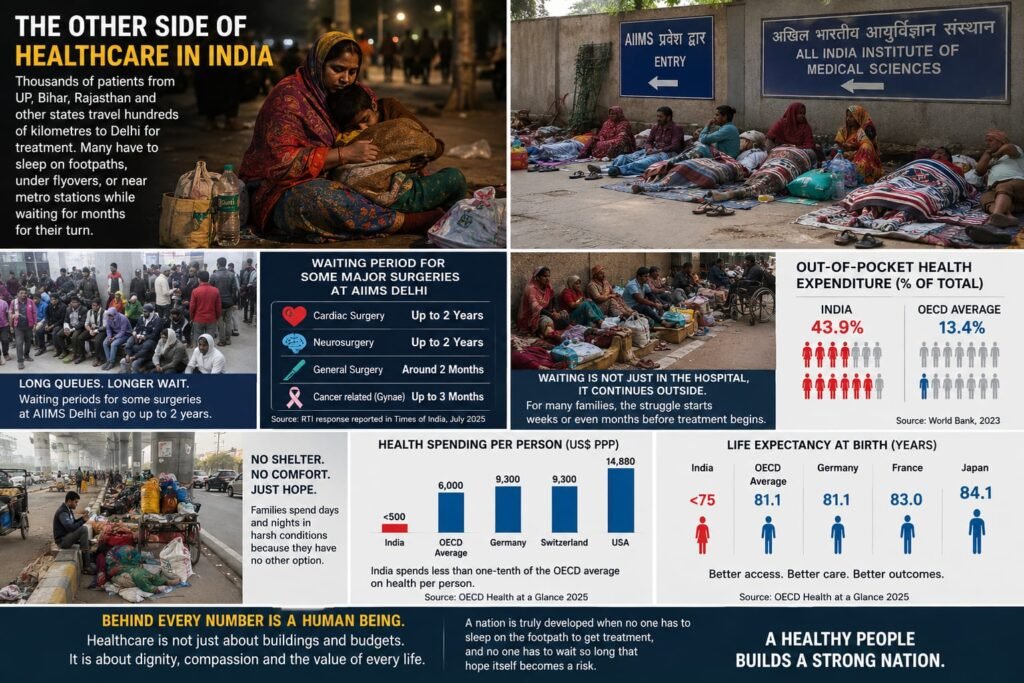
Walk around major government hospitals in Delhi, particularly around AIIMS Delhi, and one can witness a reality that is difficult to ignore. Patients and their families arrive from Uttar Pradesh, Bihar, Rajasthan and other parts of the country, carrying medical reports, medicines, small bags and often their last hopes.
Many of them cannot afford private hospitals. ,they come to Delhi because they believe that somewhere here, their loved one may get the treatment they cannot find or afford at home.
But what happens next is often heartbreaking.
Patients Living on Footpaths While Waiting for Treatment ,outside major hospitals and around metro stations, it is not uncommon to see patients and attendants sleeping or staying in extremely difficult conditions.
Some families spend days or weeks outside hospitals , Some struggle to arrange food.
Some sleep under flyovers, near metro stations or on pavements , Some depend on charitable organizations and strangers for basic necessities.
And behind every such family is a story , A father trying to save his child.
A mother waiting for her son’s treatment , An elderly husband carrying medical files for his wife.
A daughter taking care of her ageing parents.
These are not statistics.
These are human beings.
Six Months Can Mean a Lifetime , For someone suffering from a serious illness, a waiting period of several months is not simply an administrative inconvenience.
Six months can change everything.
A disease can progress , A patient’s condition can deteriorate.
A family’s savings can disappear , A daily wage earner can lose his livelihood.
Children can stop going to school because their parents are struggling to manage treatment , And sometimes, the patient may not even survive long enough to receive the treatment for which the family has been waiting.
We often discuss waiting lists as numbers , But behind every number is someone’s life.
Why Are People Travelling Hundreds of Kilometres ?
The question we should ask is not only why hospitals in Delhi are overcrowded.
We should ask:
Why does a patient from a village in Uttar Pradesh have to travel hundreds of kilometres to Delhi for specialised treatment ?
Why does a family from Bihar have to leave its home, livelihood and support system just to access basic healthcare ?
Why does a patient from Rajasthan have to spend weeks in an unfamiliar city because treatment facilities are unavailable or inaccessible closer to home ?
This reflects a deeper problem:
Healthcare infrastructure is not evenly distributed , India has some excellent hospitals and highly talented doctors. But excellence concentrated in a few major cities cannot solve the healthcare needs of hundreds of millions of people.
Human Value Cannot Depend on Money
For a wealthy person, a medical emergency may mean booking a private hospital, arranging accommodation and paying for specialised treatment.
For a poor family, the same emergency can mean selling jewellery, borrowing money, taking loans or simply waiting.
This creates an uncomfortable reality:
The value of human life should never depend upon the size of someone’s bank balance.
A poor person’s life is not worth less than the life of a wealthy person.
A farmer’s life is not worth less than the life of a corporate executive.
A daily wage worker’s child deserves the same chance to survive as the child of a millionaire.
Healthcare is not merely a service.
It is a fundamental measure of our humanity.
The Problem Is Bigger Than AIIMS.
AIIMS Delhi should not be viewed as the problem.
In fact, the enormous patient load at institutions like AIIMS reflects how much people trust these institutions and how limited specialised healthcare remains elsewhere.
The real question is:
Why are a handful of hospitals expected to carry the healthcare burden of an entire region ?
Northern India needs stronger medical infrastructure in cities such as Lucknow, Kanpur, Varanasi, Prayagraj, Gorakhpur, Patna, Jaipur, Agra and many other regional centres.
District hospitals also need better specialists, diagnostics, emergency services, equipment and trained manpower.
If quality treatment is available closer to people’s homes, families will not have to travel hundreds of kilometres and live outside hospitals simply to get medical attention.
Healthcare Needs Decentralisation.
India does not only need more hospitals.
It needs a strong healthcare network.
Primary healthcare should identify diseases early.
District hospitals should provide advanced treatment.
Regional medical centres should provide specialised services.
And national institutions should handle the most complex cases.
Such a system would reduce the pressure on Delhi’s major hospitals and, more importantly, reduce the suffering of millions of families.
The Forgotten Human Being….
Development is often measured through GDP, roads, buildings, technology and economic growth.
All of these are important.
But there is another measure that deserves equal importance:
Can an ordinary citizen fall sick without becoming financially and socially helpless?
Can a poor family receive treatment without sleeping on a pavement?
Can an elderly patient receive timely consultation without waiting months?
Can a child receive specialised treatment without his parents travelling across three states?
Can a family remain together without losing everything they own to medical expenses?
These questions are about more than healthcare.
They are about human dignity ,wMust Stop Normalising Suffering
Perhaps the most dangerous thing is that we are slowly becoming accustomed to these scenes.
We see families sleeping outside hospitals and continue walking.
We see patients waiting endlessly and call it a “system.”
We see overcrowded hospitals and say, “This is normal in India.”
No. It should not be normal.
A country with a population of more than a billion people cannot afford to normalise human suffering.
We should demand better—not only for ourselves, but for the person standing next to us.
A Nation Is Ultimately About Its People , Buildings can be rebuilt , Roads can be widened.
Metro lines can be extended, Technology can improve.
But a human life lost because timely treatment was unavailable cannot be brought back.
The true meaning of development is not simply how modern our cities look.
It is how safely, respectfully and compassionately an ordinary citizen can live.
A hospital should give hope, not become a place where a poor family loses its dignity.
Northern India needs better healthcare infrastructure, more regional centres of excellence, shorter waiting periods, affordable treatment and—above all—greater respect for the human being behind every medical file.
Because ultimately, before we are patients, citizens, employees, taxpayers or customers—
we are human beings.
And the value of a human life should never be measured by money, status or geography ,If India truly wants to become a developed nation, it must first ensure that no helpless family has to sleep outside a hospital for months simply because they cannot afford a room or private treatment.
That is not merely a healthcare challenge.
It is a test of our humanity.