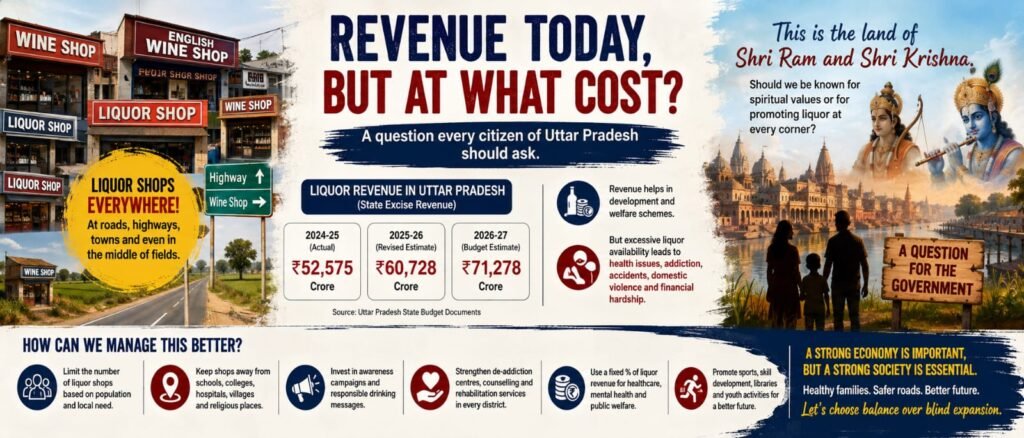
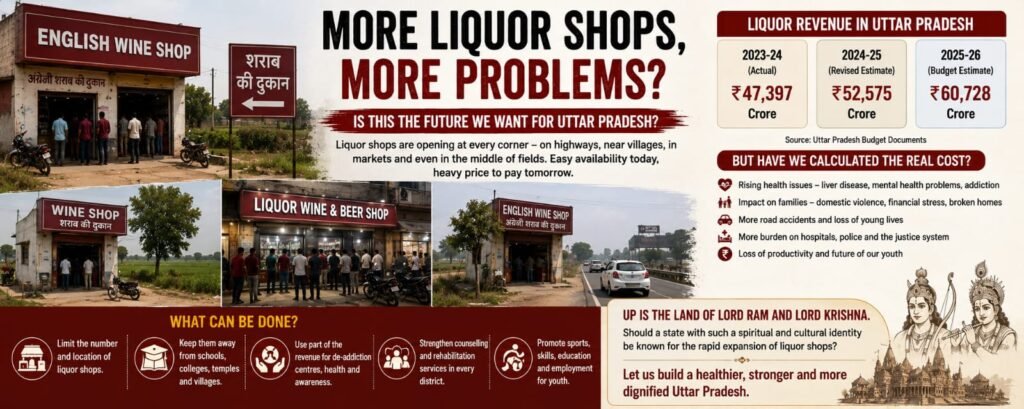
Over the last few years, Uttar Pradesh has witnessed a rapid increase in the number of liquor shops. Today, liquor outlets can be seen at road crossings, along highways, in towns, and sometimes even close to agricultural fields.
This raises an important question :
Do we really need so many liquor shops ?
Uttar Pradesh government has made excise revenue one of its major sources of income. According to the state budget, State Excise revenue increased from about ₹52,575 crore in 2024-25 to a revised estimate of around ₹60,728 crore in 2025-26, and the 2026-27 Budget projects it to reach nearly 71,278 crore ( data from The Times of India , PRS & ET ) .
To achieve these targets, the Excise Department has also announced the opening of 489 new liquor shops across 43 districts to further expand sales and increase revenue.
There is no doubt that this revenue helps the government fund development projects, infrastructure, and welfare schemes.
But is revenue the only measure of development ?
Every bottle sold may generate tax for the government, but it can also create hidden costs for families and society. Alcohol abuse is associated with road accidents, domestic violence, liver disease, mental health issues, financial hardship, and reduced productivity. Eventually, these problems place an additional burden on hospitals, police, and the public healthcare system.
This leads to another important question :
Has the government ever published a study comparing liquor revenue with the total healthcare, policing, and social costs caused by alcohol-related issues?
Can We Manage This Better ?
Instead of simply increasing the number of liquor shops, Uttar Pradesh could adopt a balanced policy:
- Restrict the number of liquor shops based on population and local demand.
- Avoid opening shops near schools, colleges, hospitals, temples, villages, and residential areas.
- Use a fixed percentage of excise revenue for de-addiction centres, mental health services, and public awareness campaigns.
- Strengthen rehabilitation programmes for people struggling with alcohol addiction.
- Promote sports, skill development, libraries, and youth centres as healthier alternatives.
What Can We Learn from Other States ?
Some states have adopted different approaches.
Gujarat has maintained prohibition for decades, while Bihar introduced a statewide liquor ban in 2016 ,These policies have faced implementation challenges, including illegal liquor trade, but they also show that governments can choose to prioritise public health and social welfare over excise revenue.
Every state has different needs, but their experience reminds us that development can be measured in many ways—not only by tax collections.
Uttar Pradesh’s Spiritual Identity ? Uttar Pradesh is the sacred land of Lord Shri Ram in Ayodhya and Lord Shri Krishna in Mathura and Vrindavan. Millions of devotees from around the world visit these places seeking spirituality, peace, and moral values.
This naturally raises a question for all of us : Should a state that represents the values of Shri Ram and Shri Krishna also continue expanding liquor shops at such a rapid pace?
This is not about imposing a complete ban. It is about finding the right balance between economic growth, public health, and our cultural values.
Questions for the Government…?
- Is increasing the number of liquor shops the only way to increase state revenue ?
- Has the government studied d long-term healthcare and social costs of alcohol consumption ?
- How much of the excise revenue is spent on de-addiction, public health, and rehabilitation ?
- Can Uttar Pradesh develop a policy that protects both its economy and its social fabric ?
- Can we create a development model that reflects the cultural and spiritual heritage of the land of Shri Ram and Shri Krishna ?
A strong economy is important , But an even stronger society is one where families are healthy, young people are empowered, roads are safer, and citizens live with dignity.
The real question is not how much revenue we earn today, but what kind of Uttar Pradesh we want to leave for the next generation…..