
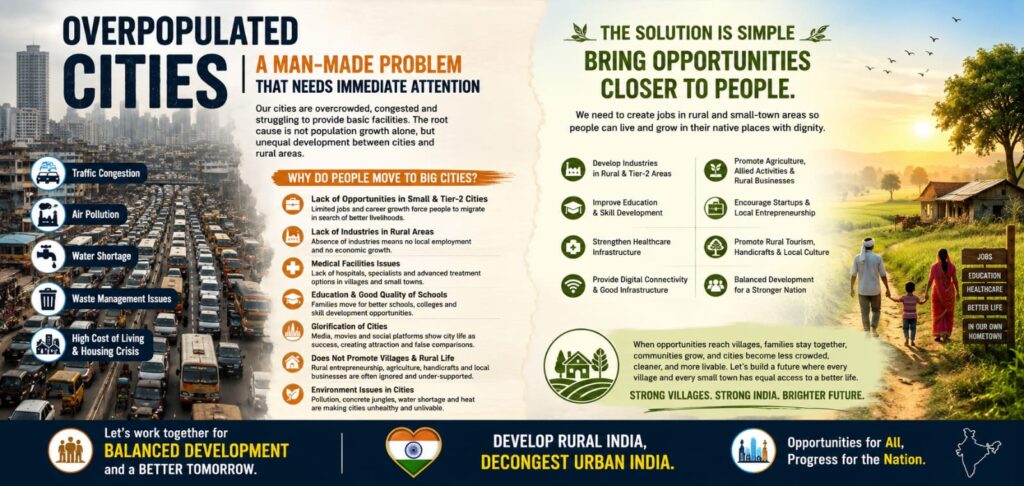
Today, many of our cities are struggling with overcrowding , roads remain congested throughout the day, public transport is overloaded, pollution is increasing, and basic facilities such as housing, healthcare, water, and sanitation are under constant pressure. While population growth plays a role, the real reason behind this problem is not the number of people—it is the unequal development between cities and rural areas.
Every year, millions of people leave their villages and small towns in search of better education, jobs, healthcare, and a better future. This migration is not always by choice. For many families, it becomes a necessity because opportunities are simply unavailable in their hometowns.
One of the biggest reasons is the lack of employment in rural and Tier-2 or Tier-3 cities. Most industries, corporate offices, IT companies, and business parks are concentrated in a few metropolitan cities. As a result, young people have no option but to migrate, leaving behind their families and villages.
Healthcare is another major concern ,Many villages and small towns still do not have quality hospitals, specialist doctors, or advanced medical facilities. During serious illnesses or emergencies, people are forced to travel to big cities, adding more pressure to urban infrastructure.
Education also plays a significant role , Parents naturally want the best future for their children. Unfortunately, many rural areas still lack high-quality schools, colleges, universities, and skill development institutes. Families often relocate permanently so their children can receive better education.
Another reason is the glorification of city life , Movies, advertisements, social media, and entertainment often present cities as symbols of success, luxury, and opportunity, while rural life receives very little positive attention. This creates the belief that success is possible only in large cities.
At the same time, villages are rarely promoted as places where people can build successful careers and enjoy a better quality of life. Rural entrepreneurship, agriculture, tourism, handicrafts, and local businesses often receive limited support and investment.
The environmental impact of overcrowded cities is becoming increasingly serious. More vehicles mean more air pollution. More construction reduces green spaces. Water shortages, waste management issues, traffic congestion, and rising temperatures are all consequences of unplanned urban expansion. Cities were never designed to support such massive populations.
The solution is not to stop people from moving. The real solution is to bring opportunities closer to where people already live.
Governments and industries should focus on creating employment in villages and smaller cities. Manufacturing units, IT parks, food processing industries, renewable energy projects, and service centres should be encouraged outside major metropolitan areas. Better schools, colleges, hospitals, internet connectivity, and public transport should become priorities in rural development.
Skill development centres and startup support can help local youth become job creators instead of job seekers. Promoting local tourism, agriculture-based businesses, handicrafts, and digital employment can also generate sustainable income in rural regions.
Balanced development will benefit everyone. When people can find quality education, healthcare, and employment near their homes, unnecessary migration will reduce. Families can stay together, villages will prosper, and cities will become cleaner, healthier, and more manageable.
The future of a nation does not depend only on developing its metropolitan cities. It depends on ensuring that every village, every small town, and every citizen has equal access to opportunities. If we truly want to solve the problem of overcrowded cities, we must begin by strengthening rural India.
good
Nice