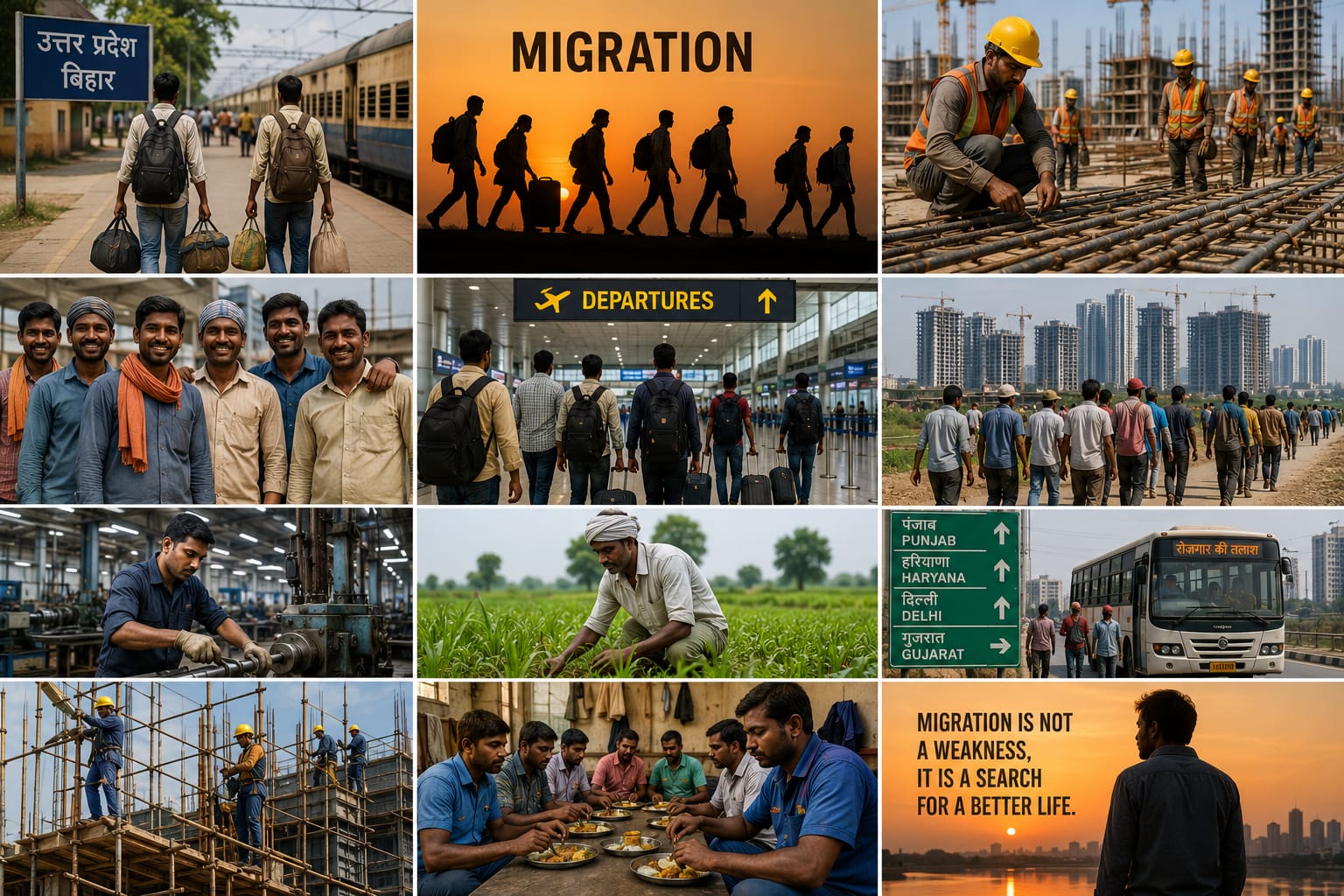
For more than a century, Uttar Pradesh and Bihar have been among the largest sources of migrant workers, not only within India but across the world. From the days when laborers were sent to Fiji, Suriname, Mauritius, and the Caribbean during the colonial era, to the present-day migration to Gulf countries and industrial states such as Gujarat, Punjab, Haryana, Maharashtra, and Delhi-NCR, the story remains remarkably similar.
This raises an important question: Why do millions of people continue to leave these states in search of better opportunities? More importantly, when will this change?
A Historical Legacy – The roots of migration from Uttar Pradesh and Bihar can be traced back to the British colonial period. Following the abolition of slavery, the British recruited thousands of laborers from these regions as indentured workers and transported them to distant colonies. Poverty, lack of opportunities, and economic hardship made people vulnerable to such recruitment.
Even after India’s independence, migration continued because the underlying economic challenges were never fully addressed.
The Population Challenge – Both Uttar Pradesh and Bihar are among India’s most populous states. Every year, millions of young people enter the workforce. While population itself is not a problem, creating enough quality jobs for such a large workforce is an enormous challenge.
When local opportunities are limited, people naturally move to regions where employment is available.
Lack of Industrial Development – States such as Gujarat, Maharashtra, Tamil Nadu, and Haryana invested heavily in industries, manufacturing, infrastructure, and urban development. These investments created millions of jobs and attracted workers from across India.
In comparison, large parts of Uttar Pradesh and Bihar remained dependent on agriculture and small businesses. While progress has been made in recent years, industrial growth has not yet reached a level that can absorb the entire workforce.
Why Do Migrants Face Discrimination ?
One unfortunate reality is that migrants often face prejudice and stereotypes. Whether in India or elsewhere in the world, people who move in search of work are sometimes viewed as outsiders.
Workers from Uttar Pradesh and Bihar have contributed immensely to the development of cities, industries, construction projects, transportation networks, and service sectors across India. Yet many continue to face social discrimination and negative stereotypes.
This is not a reflection of their capability but rather a reflection of societal attitudes that still need to change.
Signs of Change
The situation today is not the same as it was fifty years ago.
Modern expressways, airports, industrial corridors, improved connectivity, digital governance, and growing urban centers are transforming many parts of Uttar Pradesh. Bihar too has made progress in infrastructure, education, and connectivity.
Young people from these states are increasingly succeeding in government services, technology, entrepreneurship, business, education, and professional careers across the globe.
What Needs to Be Done ? The long-term solution lies in creating opportunities where people live.
- Better education and skill development.
- Strong industrial and manufacturing growth.
- Investment in infrastructure and logistics.
- Support for entrepreneurship and startups.
- Modernization of agriculture.
- Transparent and efficient governance.
- Social acceptance and respect for migrant workers.
Migration should be a choice, not a compulsion.
Looking Ahead >
The story of Uttar Pradesh and Bihar is not one of failure. It is a story of resilience, hard work, and untapped potential. The people of these states have contributed to economies around the world despite facing numerous challenges.
Hemant Sharivastava