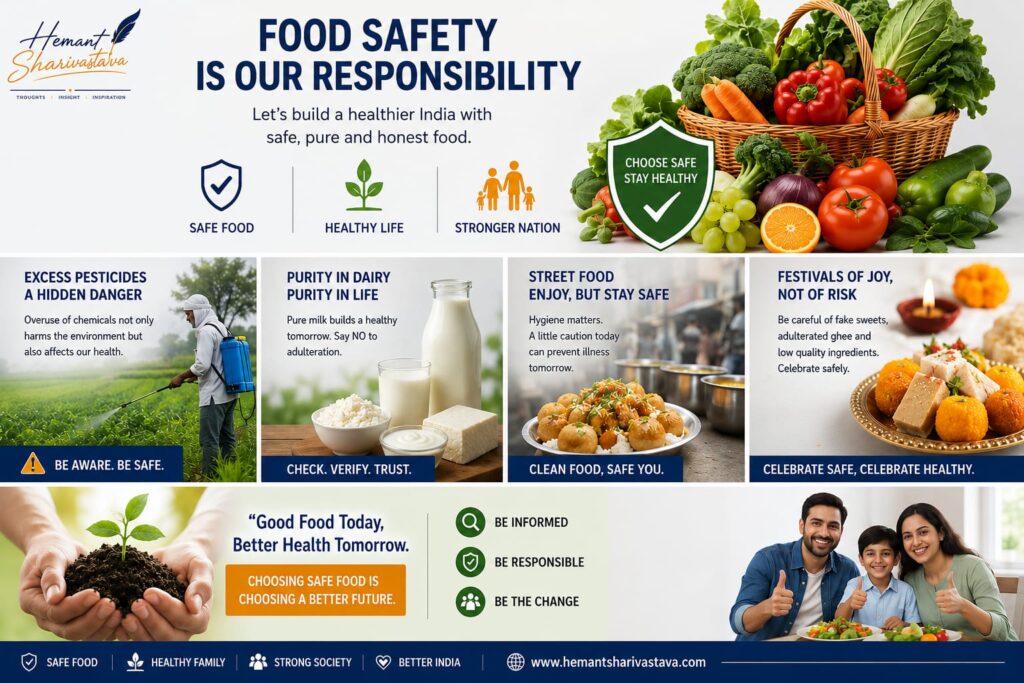
Whenever we discuss public issues, we often talk about roads, traffic, pollution, infrastructure, education, or healthcare. However, one issue that directly affects every citizen every single day receives surprisingly little attention – the safety and quality of our food.
Every day we consume fruits, vegetables, milk, curd, butter, ghee, sweets, street food, and countless other food items. But how many of us really know what is going into them before they reach our plates ?
Today, it is becoming increasingly difficult to find fruits and vegetables that are completely free from excessive pesticides, herbicides, fertilizers, and other chemicals. While these products were introduced to support farming and improve productivity, they were never meant to be used excessively.
Many fruits available in markets appear perfectly coloured and attractive, but there are frequent concerns regarding artificial ripening. Bananas, mangoes, papayas and several other fruits are often suspected of being chemically ripened to meet market demand quickly.
The bigger concern is that most consumers have no way of knowing how much pesticide or chemical residue remains on the fruits and vegetables they purchase.
Organic food is often discussed, but genuinely organic produce is still rare and expensive for the common citizen. Most of us ultimately depend on conventionally grown food and simply hope that it is safe.
” The dairy sector raises another important question”
India has a huge population , Every day we consume enormous quantities of milk, curd, buttermilk, paneer, butter, cheese, sweets, khoa and ghee. We also export dairy products. Sometimes one wonders how such vast demand is continuously met while reports of adulteration, synthetic milk and fake dairy products continue to surface from different parts of the country.
Another concern rarely discussed is the quality of animal feed. If cattle consume fodder grown using excessive pesticides and chemicals, can their milk remain completely unaffected? This is a question that deserves scientific study and public discussion.
”Then there is the issue of street food”
Street food is part of our culture and supports millions of livelihoods. However, in many places food is prepared and served amidst dust, pollution, open drains, traffic fumes and unhygienic surroundings. Sometimes one can see food items left uncovered for hours while vehicles continuously pass nearby.
What is even more surprising is that despite regular discussions on public health, hygiene standards at many food establishments still remain a challenge.
Almost every year before Holi, Deepawali and other festivals, news reports emerge about fake sweets, adulterated milk products, synthetic khoa, duplicate ghee and low-quality edible oils. Authorities conduct raids and seize large quantities of such products. Yet the same stories seem to repeat every year.
These naturally raises a question ?
Are we addressing the root cause, or merely reacting to the problem after it has already reached the market ?
In my view, excessive population pressure is also one of the factors behind this situation. Demand is enormous. Sellers know that even if some customers reject a product due to quality concerns, there will always be other buyers.
As a result, quantity often receives greater importance than quality.
India certainly has food safety regulations and monitoring agencies. However, considering the size of our country and the scale of food production, one wonders whether monitoring mechanisms are sufficient to ensure compliance at every level.
Food safety should not remain limited to occasional raids or seasonal inspections.
We need stronger and more frequent testing of fruits, vegetables, milk and processed foods. We need stricter action against repeat offenders. We need greater transparency regarding pesticide usage. We need better hygiene standards for food establishments and roadside vendors. Most importantly, consumers need access to reliable information about the food they purchase.
Food is not merely a commodity. It is the foundation of public health.
If we continue ignoring food quality today, we may face much larger health challenges tomorrow. Rising lifestyle diseases, digestive disorders, allergies and other health concerns cannot be discussed separately from the quality of food we consume every day.
The question is not whether this issue exists.
The real question is: Why are we discussing it so little ?
A country of over a billion people deserves not only enough food, but safe food.
Perhaps it is time for food safety to become a national conversation rather than an occasional concern.