
Vrindavan is not merely a city; it is a sacred emotion for millions of devotees who come seeking peace, devotion, and a connection with Lord Krishna. Every lane, temple, ghat, and tree carries spiritual significance. As the number of pilgrims continues to grow, it becomes our collective responsibility to preserve the purity, beauty, and divinity of this holy land .
A Cleaner and More Organized Parikrama Marg
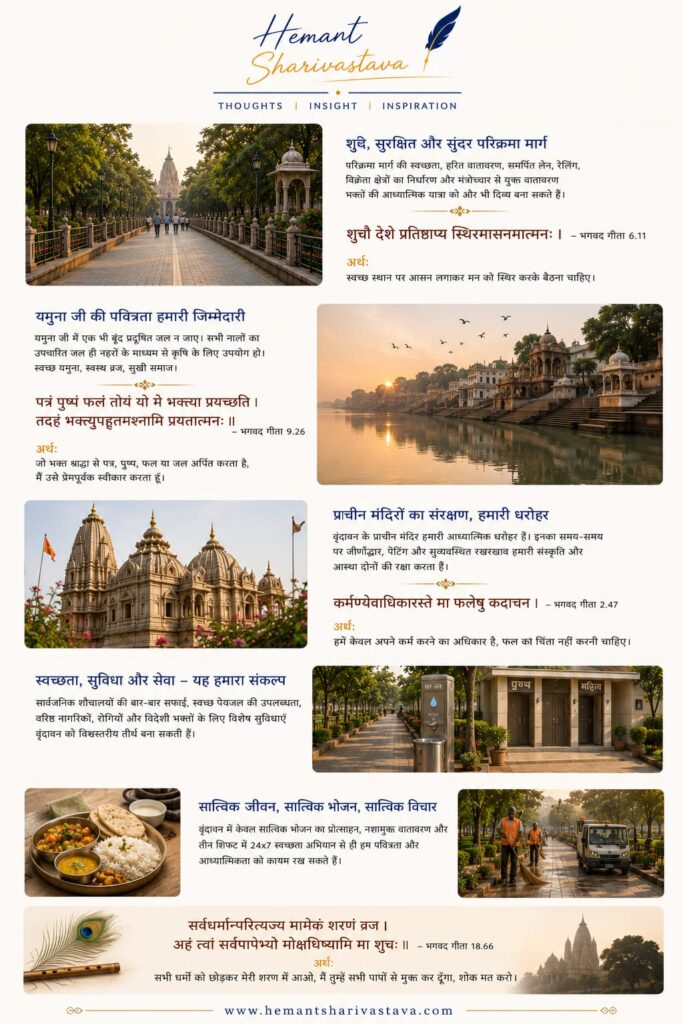
The Parikrama Marg should reflect the sanctity of Vrindavan itself. Daily mechanized cleaning, strict penalties for spitting and littering, dedicated lanes for pedestrians, Dandvati Parikrama devotees, and electric vehicles can greatly improve the experience of devotees.
Continuous railings on both sides, lush greenery, shaded resting points, and devotional music playing Krishna bhajans and Maha Mantra chanting can transform the entire route into a truly spiritual journey. Roadside vendors should be shifted to designated vending zones every 100–200 meters, ensuring both convenience and cleanliness.
“शुचौ देशे प्रतिष्ठाप्य स्थिरमासनमात्मनः।” — Bhagavad Gita 6.11
A clean and sacred environment naturally helps the mind focus on devotion and spiritual practice.
Yamuna Ji and Temple Heritage
No vision for Vrindavan can be complete without restoring the purity of Yamuna Ji. Untreated sewage and drainage water should never enter the holy river. Modern treatment plants must process wastewater before it is diverted for agricultural use through canals.
Similarly, the ancient temples of Vrindavan deserve special attention. Structural repairs, repainting every two years, improved lighting, landscaping, and heritage conservation efforts are essential to preserve these priceless symbols of devotion for future generations.
“पत्रं पुष्पं फलं तोयं यो मे भक्त्या प्रयच्छति। तदहं भक्त्युपहृतमश्नामि प्रयतात्मनः॥” — Bhagavad Gita 9.26
Lord Krishna accepts even a leaf, flower, fruit, or water when offered with devotion. Keeping His sacred land and rivers pure is also an act of devotion.
Ashrams operated by trusts and NGOs should maintain transparent and affordable pricing while ensuring cleanliness, safety, healthcare support, and dignity for residents. Special facilities should be created for senior citizens, differently-abled devotees, and foreign visitors through wheelchair-friendly pathways, electric shuttles, multilingual signboards, and medical assistance centers.
As a sacred dham, Vrindavan should promote only Satvik food. The sale of alcohol, tobacco products, cigarettes, gutka, paan masala, and other intoxicants should be prohibited within pilgrimage zones to preserve the spiritual atmosphere of the city.
Automatic drinking water vending machines should be installed across major routes, temples, ghats, and public gathering areas to ensure that pilgrims always have access to clean drinking water.
“युक्ताहारविहारस्य युक्तचेष्टस्य कर्मसु।युक्तस्वप्नावबोधस्य योगो भवति दुःखहा॥” — Bhagavad Gita 6.17
Balance, purity, and discipline in daily life create harmony and well-being for individuals and society alike.
Cleanliness: The Highest Service to Vrindavan
One of the biggest challenges facing Vrindavan today is sanitation. Modern public toilets should be developed at regular intervals and cleaned every three to four hours. This should be considered non-negotiable in a city that welcomes millions of pilgrims every year.
To address the massive daily footfall, cleanliness operations should run continuously in three shifts: midnight to 8 AM, 8 AM to 4 PM, and 4 PM to midnight. Dedicated teams from the Mathura-Vrindavan Municipal Corporation should work round the clock to maintain roads, drains, public toilets, ghats, parks, and temple surroundings.
Additional initiatives such as plastic-free zones, electric public transport, smart parking systems, rainwater harvesting, underground utility lines, security monitoring, and large-scale tree plantation drives can further enhance the city’s spiritual and environmental health.
कर्मण्येवाधिकारस्ते मा फलेषु कदाचन।”— Bhagavad Gita 2.47
Our duty is to perform righteous action without attachment to results. Serving and preserving Vrindavan is one such sacred duty.
Vrindavan is not just a destination; it is a living symbol of devotion, faith, and divine love. A cleaner Parikrama Marg, a purified Yamuna Ji, restored temples, organized infrastructure, disciplined civic management, and compassionate facilities can help preserve its sacred identity for generations to come.
If spirituality and civic responsibility walk together, Vrindavan can become a global model of pilgrimage management while retaining its eternal connection with Lord Krishna. Such efforts will create an atmosphere where devotees can experience deeper peace, stronger positive vibrations, and a more profound connection with Bhagwan.
“सर्वधर्मान्परित्यज्य मामेकं शरणं व्रज। अहं त्वां सर्वपापेभ्यो मोक्षयिष्यामि मा शुचः॥”— Bhagavad Gita 18.66
“The true service of Vrindavan is not only to visit its temples, but also to preserve its cleanliness, spirituality, and sacred heritage for future generations.”
I understood very positive things.